SAIN Utrecht
AI Safety in the heart of the Netherlands. Building a multidisciplinary community at Utrecht University and beyond, with international backing and a growing research focus.
We are recruiting
Open roles at SAIN Utrecht
Help us grow the chapter. Applications are reviewed on a rolling basis.

Events
Past & upcoming events
Upcoming events — see details on lu.ma/bsv03bzb.
Past events this academic year — recaps on linkedin.com/company/sain-utrecht.
No past events in this list yet for the current academic year.
Events: eventsutr@safeainetherlands.org
Programs
What we run in Utrecht
Courses
AI Safety Fundamentals
Sign up to participate in the upcoming courses or to become a facilitator!
Participant deadline: 18 September. Facilitator deadline: 15 September.
SAIN Utrecht's AI Safety Fundamentals series has run across three iterations, reaching BSc/MSc students, researchers, engineers, and public-sector participants — more than 100 across three editions. Each week spotlights a different theme so newcomers can drop in and keep coming back for the next session. During the 4th week, participants can choose to follow a technical or governance path. It is possible to participate in both paths, but the technical path is more demanding as it will introduce more advanced concepts. Each week pairs a lecture with a discussion group, and participants can also join the local community to continue the conversation. The discussion group schedule is available on our Luma page.
Course outline (weekly themes)
- 1.Introduction — High-level overview of AI safety, why it matters now, capabilities & diffusion, types of risks and solution strategies (technical & governance).
- 2.Types of risks & incidents — Social harms, frontier risks, misuse, loss of control; real-world cases and how research lags deployment.
- 3.Why AI Safety is difficult — Industry incentives, funding gaps, expert disagreement, slow regulation vs. fast labs, geopolitical race dynamics.
- 4.Path specialization — You choose one or both of the following paths:
Technical Path
Robustness & jailbreaking, scalable oversight, alignment, evaluations, cybersecurity and agents.
Governance Path
Regulations, the EU AI act, accountability, and international actors.
Course details
- Duration
- 4 weeks
- Workload
- 1h readings + 1h lecture / week
- Format
- On-site in Utrecht
- Venue
- Utrecht University, Utrecht city center
- Certification
- Certificate upon attending all sessions. Discussion groups are optional. Participating in one of the two paths in week 4 is enough to get the certificate.
- Audience
- Students, researchers, professionals. No previous background requested
Topics and timings may shift by cohort — email us for the latest schedule.
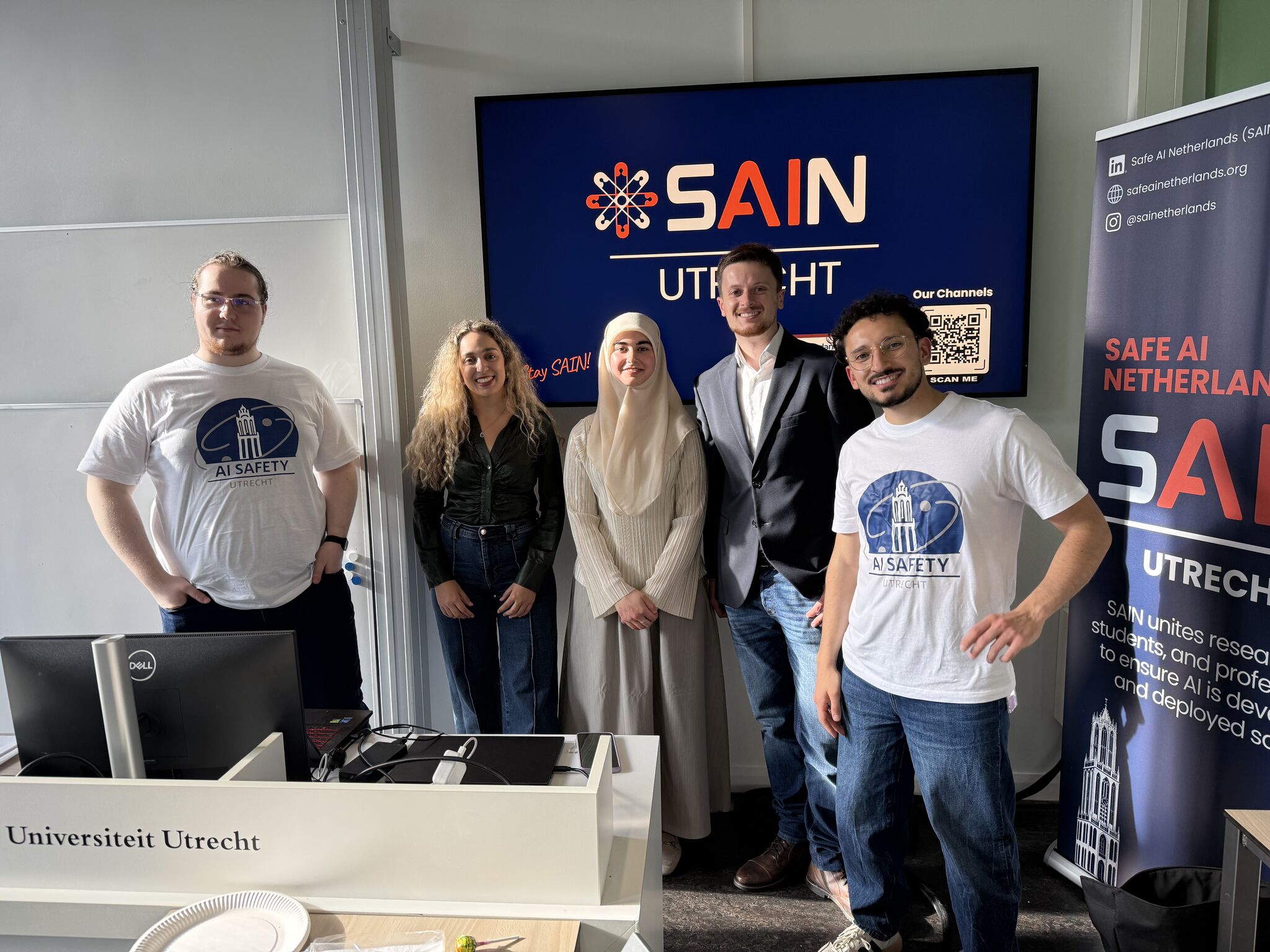
Cohort highlight
Program graduation
Courses
Technical AI Safety
SAIN Utrecht is the first SAIN chapter teaching from ARENA materials — a four-week technical track from transformer foundations through mechanistic interpretability and alignment, with weekly lectures, notebook exercises, and in-person discussion at Utrecht University.
Course outline (weekly themes)
- 1.Transformers & mechanistic interpretability — From RNNs to modern transformers: tokenization, embeddings, attention, and how models project back to vocabulary. Introduction to reverse-engineering neural networks via weights, activations, and internal circuits.
- 2.Probing & representations — Linear probes as detectors in activation space (truth, deception); SAE-based feature decomposition; activation oracles for open-ended questions about model internals. Risk-triage exercises for high-stakes monitoring scenarios.
- 3.PPO & RLHF — Why naive policy gradients fail and how PPO stabilises training. The full alignment pipeline: supervised fine-tuning, reward-model training, and PPO optimisation — with the KL penalty as a guard against reward hacking.
- 4.RLHF, GRPO & reward hacking — The transformer as an RL agent (tokens as actions, preference as reward). Value heads and actor–critic setups; GRPO with LoRA fine-tuning. Observing reward hacking in practice — mode collapse, prefix exploitation, and mitigation strategies.
Each week pairs a lecture with ARENA-inspired notebook assignments using tools such as TransformerLens, SAELens, and Neuronpedia. Completing the notebooks and attending in person is required for the certificate of completion; lectures are also streamed online for remote participants.
Course details
- Duration
- 4 weeks
- Sessions
- Weekly lectures (~90 min) + notebooks
- Format
- In-person lectures, streamed online; hands-on exercises & discussion
- Venue
- Utrecht University
- Certificate
- Complete notebooks & attend in person
- Prerequisites
- Python; linear algebra & probability
- Materials
- Based on ARENA open curriculum
Technical cohort logistics may differ from fundamentals — email for the current plan.
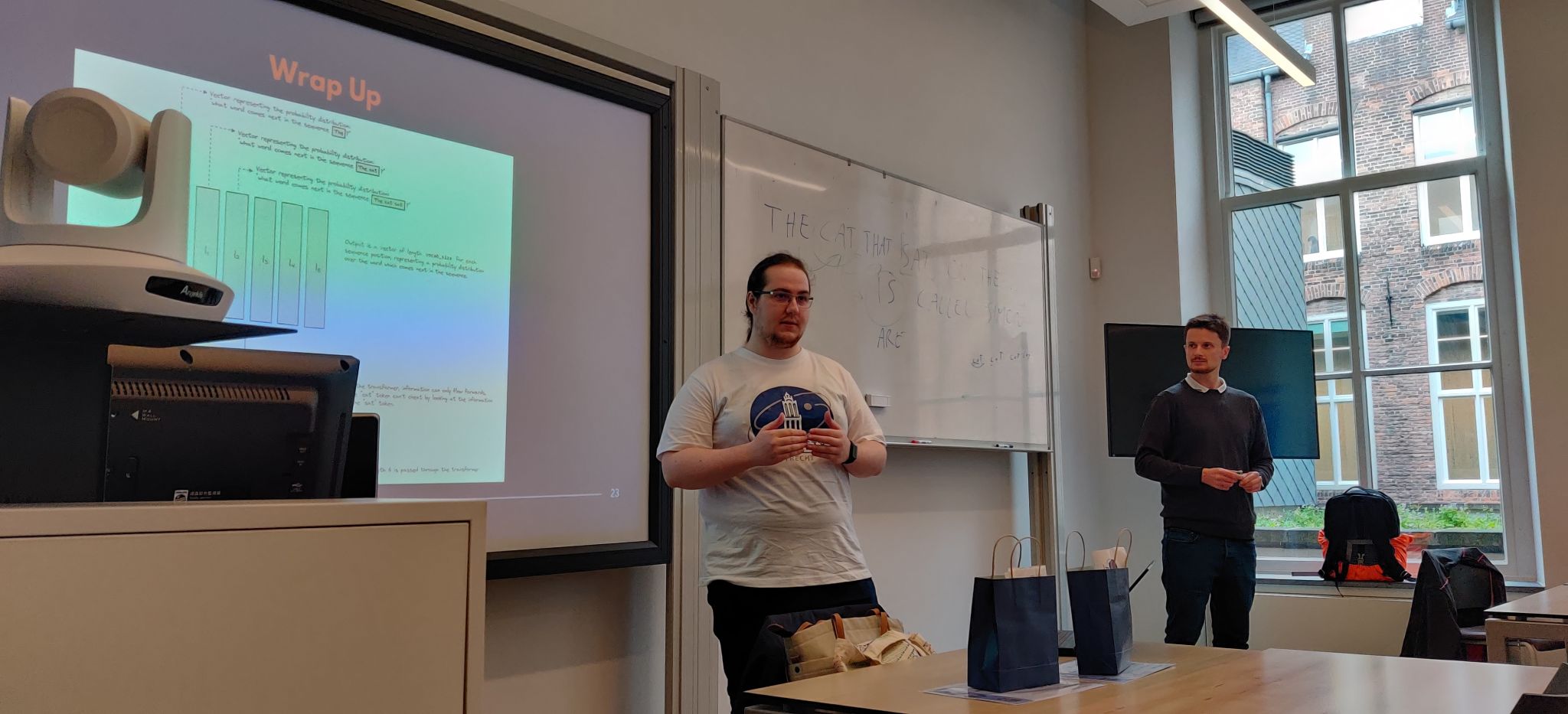
Week 1
Transformers & mechanistic interpretability
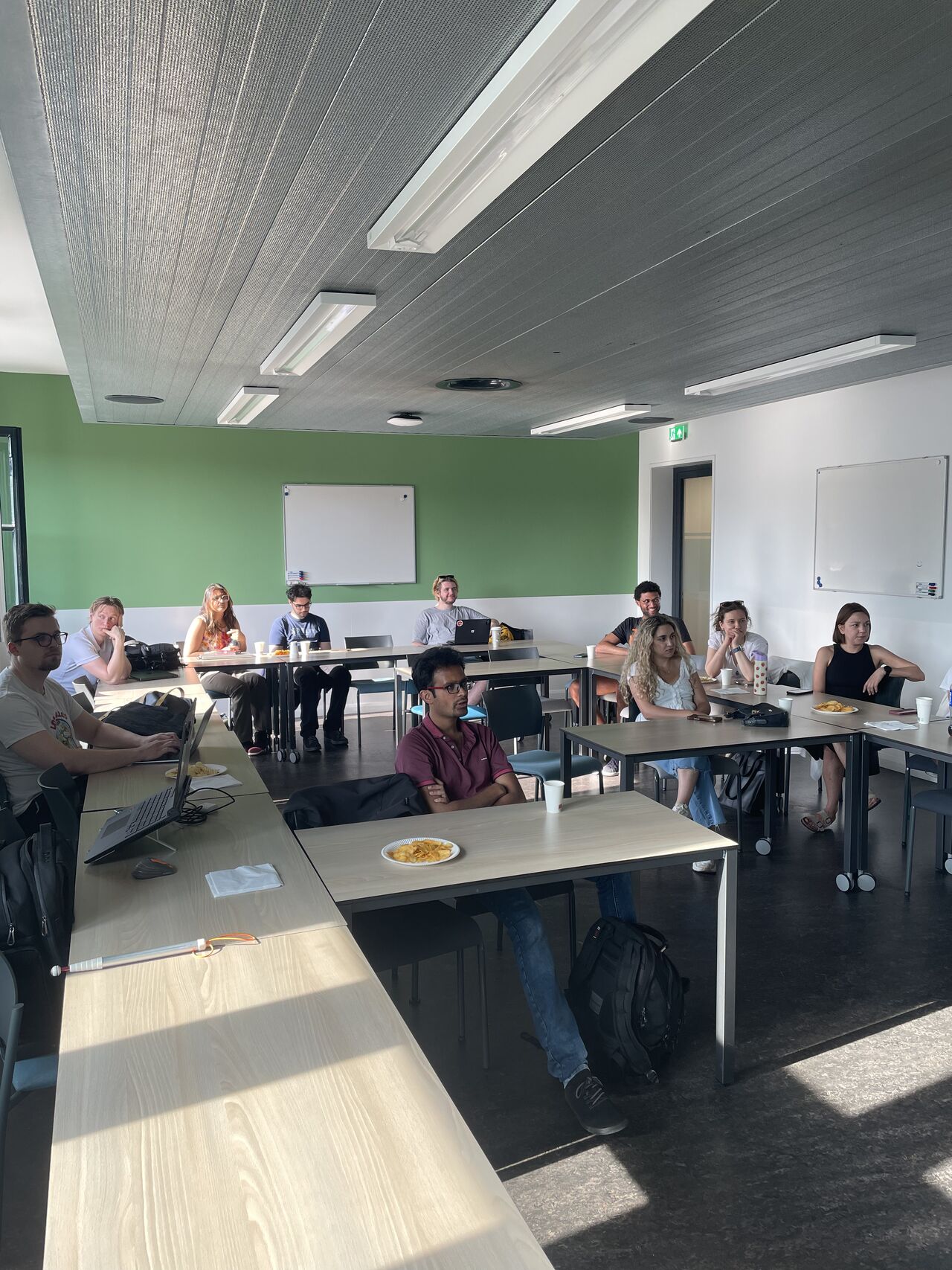
Week 2
Probing & representations
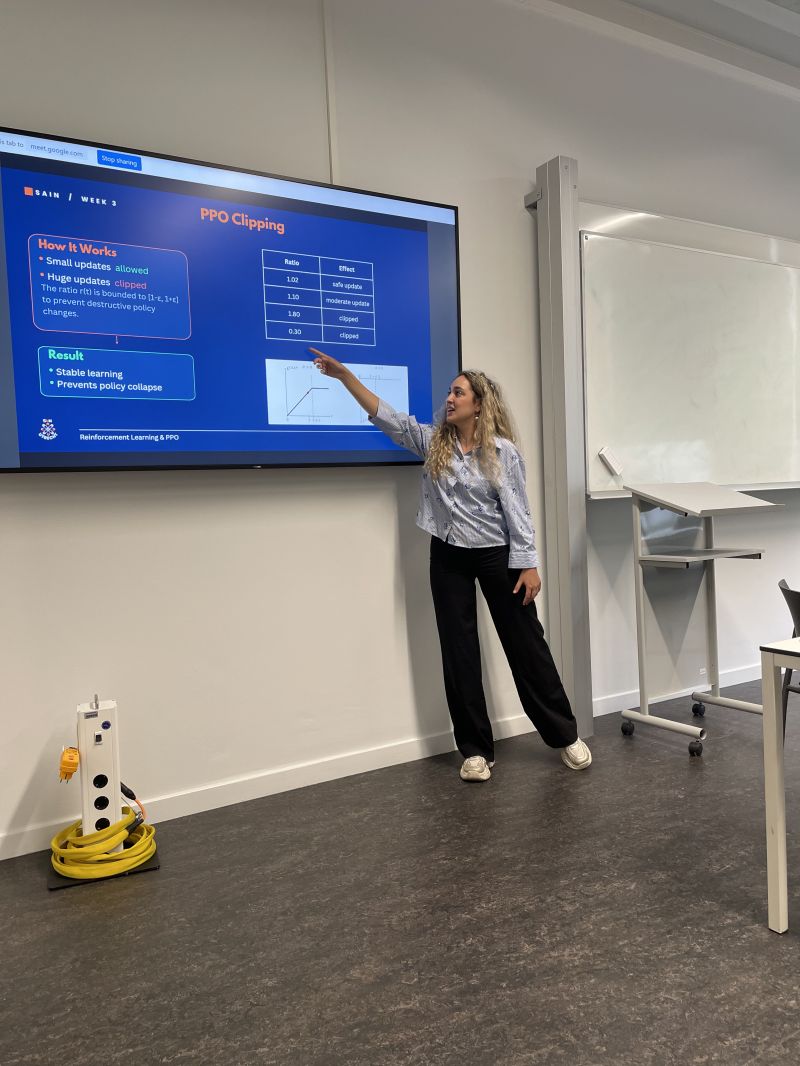
Week 3
PPO & RLHF
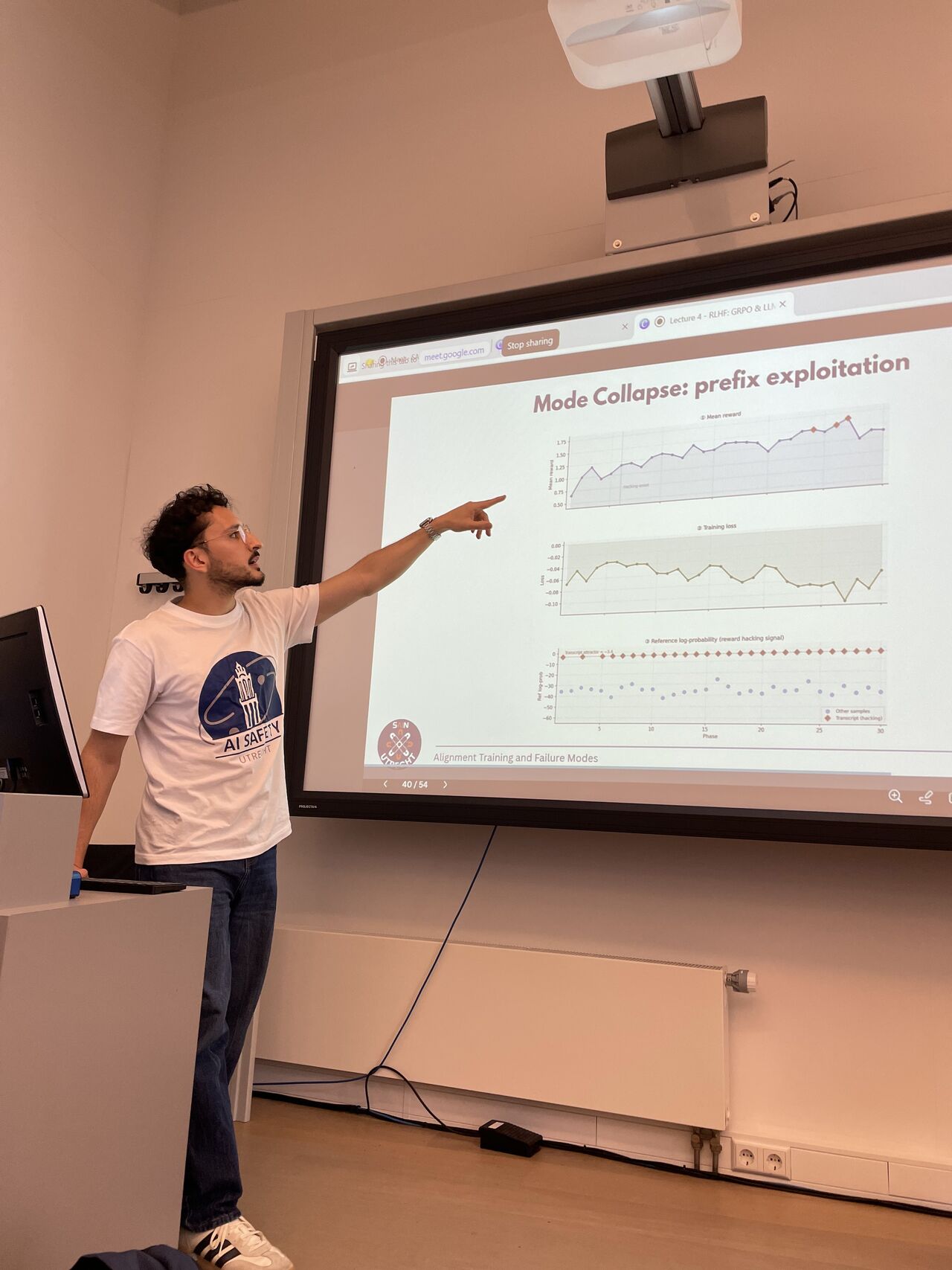
Week 4
RLHF, GRPO & reward hacking
These courses are independently led by SAIN Utrecht and are not affiliated with UU.
Questions about the course? eduutr@safeainetherlands.org
Discussion groups
Weekly research & discussion groups
Focused groups meeting weekly to discuss and learn about specific AI Safety topics. Connecting students, researchers, and practitioners for deeper engagement.
Technical AI Safety
Building learning pathways in Technical AI Safety topics including Mechanistic Interpretability. Reading and discussing current research with a focus on practical understanding.
AI Governance & Policy
Exploring regulatory frameworks, risk management approaches, and governance structures for AI systems. Connecting academic insights with real-world policy challenges.
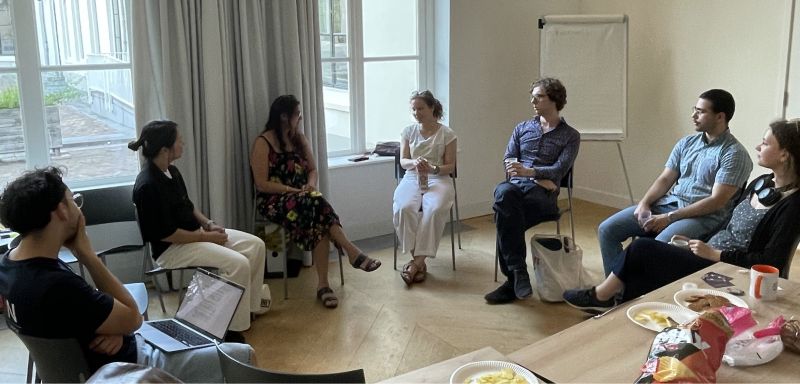
In session
Europe 2031 scenario discussion
Questions about discussion groups? eduutr@safeainetherlands.org
Research
Current research directions
SAIN Utrecht is expanding from education toward a research-enabled hub — including early-stage work on red-teaming LLMs, safety evaluation, interpretability, and agent behavior. Chapter research isn't limited to these themes; connect via the Research Hub for collaboration across SAIN.
Research Hub launch
October 2026
Members of SAIN Utrecht contributed to this research.
About
Where AI safety meets diverse expertise
SAIN Utrecht brings AI Safety to the heart of the Netherlands, engaging a multidisciplinary community of students, researchers, and professionals at Utrecht University and beyond.
The chapter is the first AI safety initiative in the Netherlands with both international funding (from BERI) and mentorship integration (from Pathfinder). This unique position enables Utrecht to bridge academic research with practical AI safety work.
Under Riccardo Campanella's leadership, SAIN Utrecht is transitioning from an education-first initiative to a research-enabled hub, with early-stage work on red-teaming LLMs, safety evaluation, interpretability, and agent behavior.
Chapter highlights
- 3 iterations of the AI Safety Fundamentals program delivered
- 100+ participants across three editions of the program
- Funded by BERI with mentorship from Pathfinder
- Guest speaker events including researchers from Anthropic (60+ attendees)
- Active local community of 240+ members
- LinkedIn engagement rate of ~9% (well above 2% benchmark)
- Growing team with focus on doubling to 15 members across 4 teams
Join & contact
Fill in our onboarding form to get involved. Subscribe to the national Substack for articles and updates across SAIN.
Email the right team to contact SAIN Utrecht